
The Artist
Explore the life, studio history, Taos years, and lasting legacy of R.C. Gorman through gallery narrative, photographs, and collector context.
An American Artist With an Unmistakable Voice
R.C. Gorman was a celebrated Diné (Navajo) artist whose paintings, drawings, and prints brought a distinctly contemporary vision of Native American life to audiences around the world. Born in Chinle, Arizona, in 1931, Gorman grew from a child who drew on rock, sand, and mud in Canyon de Chelly into one of the most recognizable artists to emerge from the American Southwest.
Gorman became especially known for his graceful portrayals of Native women. His figures are often monumental yet intimate, defined by confident lines, simplified forms, expressive gestures, and rich areas of color. Although his work remained deeply connected to the people, landscape, and cultural heritage that shaped him, Gorman also drew from formal art study, modernism, international travel, and decades of experimentation with painting, drawing, lithography, ceramics, and other media.
His career also helped expand the place of contemporary Native artists within the broader American art world. After establishing himself in Taos, New Mexico, Gorman opened the Navajo Gallery there in 1968 and built a career that reached collectors, publishers, galleries, and museums throughout the United States and abroad. Over more than four decades, his distinctive visual language made him an important figure in modern Southwestern and Native American art while establishing a legacy that continues to reach new generations of collectors and viewers.
Follow the people, places, breakthroughs, and defining moments that shaped R.C. Gorman's life and work.
↓Explore R.C. Gorman’s Life & Legacy
Choose an era to follow the people, places, artistic breakthroughs, and defining moments that shaped his life and career.
1868–2006 · 48 milestones
Origins & Family
1868–1930 · 2 eventsFamily history, Navajo heritage, and the artistic example that preceded R.C. Gorman.
Choose an era to begin. Inside each era, select any milestone to open its story or use the arrow keys to move through the chronology. Select any milestone for its story. Arrow keys move between events, and Ctrl/Command + wheel inspects a dense group of years. Tap any milestone for its story, or swipe the story panel down to close it.
Family Roots After the Long Walk
R.C. Gorman’s great-grandfather, Peshlakai, returned to Canyon de Chelly after surviving the Long Walk and confinement at Bosque Redondo.
Peshlakai returned to the Navajo homeland at Canyon de Chelly after surviving capture, the Long Walk, and four years of confinement at Bosque Redondo. During that period he learned silversmithing, establishing an artistic and cultural lineage that preceded R.C. Gorman by several generations.
Carl Nelson Gorman Is Born
R.C. Gorman’s father, Carl Nelson Gorman, became an artist, educator, and Navajo Code Talker during World War II.
Carl Nelson Gorman was born near Chinle, Arizona. He later became a recognized artist who moved beyond conventional expectations for Native painting and served with the U.S. Marine Corps as a Navajo Code Talker during World War II. His example connected artistic experimentation, Navajo identity, and public service within R.C. Gorman’s immediate family.
Born in Chinle, Arizona
Earliest Drawings in Canyon de Chelly
Gorman began drawing at about three years old, working on rock, sand, and mud while helping tend sheep in Canyon de Chelly.
Gorman was drawing by the age of three. Helping his aunts tend sheep in Canyon de Chelly, he used whatever surface was to hand — rock faces, sand, and mud — and shaped small figures from clay he found there. His earliest recorded subjects were characters he had seen rather than the Navajo women who would later define his work: Mickey Mouse and Shirley Temple.
He grew up in a traditional Navajo hogan, and his grandmother had a central part in raising him. She recounted Navajo stories and traced his descent through a line of artist ancestors, which he credited with giving him the ambition to become an artist himself.
School Years Across Arizona
Gorman attended schools in Chinle and at several Arizona mission and boarding schools before graduating from Ganado Mission High School.
Gorman began at Chinle Public School and later attended St. Michaels, a Catholic boarding school on the Navajo Reservation, followed by a Presbyterian mission school. He graduated from Ganado Mission High School in 1950. These years exposed him to several educational environments while he remained connected to the landscapes and communities of northern Arizona.
A Teacher at Ganado Sets the Course
Gorman credited Jenny Lind, a teacher at the Ganado Presbyterian Mission School, with the encouragement that led him to pursue art full time.
Among the several schools Gorman attended across northern Arizona, it was at the Ganado Presbyterian Mission School that a teacher named Jenny Lind recognised what he was doing and pressed him to take it seriously. He named her throughout his life as the person who convinced him that a full-time career as an artist was possible.
Begins College in Flagstaff
After high school, Gorman enrolled at Arizona State College in Flagstaff, now Northern Arizona University.
Following his graduation from Ganado Mission High School, Gorman enrolled at Arizona State College in Flagstaff, the institution now known as Northern Arizona University. He majored in literature and took art as his minor — a detail worth noting in an artist whose titles and published books show a writer’s ear.
His formal studies were interrupted by military service, but he later returned to the college and continued developing as an artist.
U.S. Navy Service and Study in Guam
Gorman served in the United States Navy and studied at Guam Territorial College while stationed in Guam.
Gorman served in the United States Navy from 1951 through 1955. While stationed in Guam, he attended Guam Territorial College. The experience broadened his perspective beyond the Southwest before he returned to Arizona and resumed his college education.
Creates His First Etching
Gorman drew and printed his first etching, Apache Devil Dancer, while attending college in Flagstaff.
While studying in Flagstaff, Gorman created and printed his first etching, Apache Devil Dancer. This early experiment introduced a printmaking practice that would become central to his career and eventually connect him with major workshops and master printers around the world.
Studies Art in Mexico City
A Navajo Tribal Scholarship enabled Gorman to study at Mexico City College, now the University of the Americas.
Gorman entered Mexico City College on a Navajo Tribal Scholarship, one of a small number awarded for study outside the United States. Living and studying in Mexico exposed him to modernist art, mural traditions, new printmaking methods, and a cosmopolitan art community that helped shape his independent visual language.
The Mexican Modernists and a Turn to Abstract Realism
Study in Mexico introduced Gorman to Rivera, Siqueiros, and Tamayo, and moved his work from abstraction toward the abstract realism he became known for.
In Mexico Gorman encountered the work of the social realists — Diego Rivera, David Siqueiros, and Rufino Tamayo — and their handling of colour and form redirected his own. He moved away from abstraction and toward what is usually described as abstract realism: recognisable figures built from simplified, abstracted shapes.
That approach became the basis of the style collectors recognise immediately. He also learned stone lithography there from the master printer Jose Sanchez, often drawing directly onto the stone, and returned to the medium for the rest of his career.
Study in San Francisco
Gorman continued his art studies at San Francisco State University, supporting himself in part by working as a model.
After Mexico, Gorman studied art at San Francisco State University. He supported himself during this period partly by working as a model. The San Francisco years placed him in a large urban art community for the first time and set up the exhibitions and organising work that followed there in the mid-1960s.
First San Francisco Exhibitions
Gorman’s work was exhibited at the Zieniewicz Gallery and Coffee Gallery in San Francisco.
Gorman received his first recorded gallery exhibitions in San Francisco at the Zieniewicz Gallery and the Coffee Gallery. These presentations marked his emergence as a professional artist and placed his work before audiences outside the Southwest.
Father-and-Son Museum Exhibition
R.C. and Carl Gorman appeared together in New Directions in American Indian Art at the Philbrook Art Center in Tulsa.
R.C. Gorman and his father, Carl Nelson Gorman, were featured in a two-person invitational exhibition titled New Directions in American Indian Art at the Philbrook Art Center in Tulsa, Oklahoma. The exhibition presented contemporary Native artists as individual innovators rather than treating their work only through traditional categories.
First Visit to Taos
Gorman visited Taos and met Henry Manchester and the painter Dorothy Brett, leading to an exhibition the following year.
Gorman travelled to Taos and met Henry Manchester, who ran a gallery there, and the painter Dorothy Brett. The introduction produced an agreement to show his work the next year. It was the beginning of the association with Taos that would define the rest of his career and, four years later, give him a gallery of his own.
Father and Son at the Heard Museum
R.C. and Carl Gorman exhibited together in Phoenix, and an Arizona Republic review cast them as rebels in Indian art.
R.C. and his father Carl exhibited together at the Heard Museum’s Gallery of Indian Art in Phoenix. Reviewing the show in the Arizona Republic, the critic John Becklaw ran it under a headline describing the Gormans as father-and-son rebels in Indian art — an early public framing of R.C. as an artist working against the expectations then placed on Native painters.
First Taos Exhibition Sells Out
Gorman’s first exhibition at the Manchester gallery in Taos sold out, establishing the market that would support the rest of his career.
The exhibition arranged the previous year opened at the Manchester gallery in Taos — Gorman’s first there — and sold out. The result settled the question of whether his work could support him, and it tied his reputation to Taos rather than to San Francisco or Arizona. When the gallery came up for sale three years later, he bought it.
Produces His First Lithographs
Working with printer Jose Sanchez in Mexico City, Gorman produced his first lithographs and earned major exhibition awards.
Gorman produced his first lithographs with printer Jose Sanchez in Mexico City. During the same period he helped organize the American Indian Artists Group in San Francisco and served as chairman of its painting committee. His work received top awards at several prominent Native art exhibitions, signaling a major advance in his national reputation.
Establishes the Navajo Gallery in Taos
After exhibiting at Manchester Gallery in Taos, Gorman purchased the gallery and renamed it the Navajo Gallery.
Following an exhibition at Manchester Gallery in Taos, Gorman purchased the gallery and renamed it the Navajo Gallery. The space became both a commercial base and a cultural landmark, giving him direct control over the presentation of his work and helping establish Taos as the center of his public career.
Begins the Homage to Navajo Women Suite
Gorman made his first lithographs at Tamarind Institute and began the Homage to Navajo Women suite.
At Tamarind Institute in Albuquerque, Gorman began a sustained collaboration with professional lithographers and produced his first prints there. Work also began on the Homage to Navajo Women suite, an important body of images that brought his monumental treatment of Navajo women into the medium of fine-art lithography.
Completes Two Landmark Print Suites
Gorman completed Homage to Navajo Women and Bodies by Gorman at Tamarind Institute.
Gorman completed the Homage to Navajo Women suite and the Bodies by Gorman suite at Tamarind Institute. Together, the projects demonstrated the range of his figure studies and strengthened his reputation as an artist who could translate sensuous drawing into technically sophisticated editioned prints.
The Only Living Artist at the Metropolitan
Gorman was the only living artist included in the Metropolitan Museum’s Masterworks exhibition, and the New York Times called him the Picasso of American Indian art.
Of all the artists represented in Masterworks from the Museum of the American Indian at the Metropolitan Museum of Art, Gorman was the only one still living. Two of his pieces were chosen for the front and back of the exhibition catalogue.
Reviewing the show, the New York Times described him as the Picasso of American Indian art. The comparison followed him for the rest of his life and remains the phrase most often attached to his name — a measure of how far his standing had moved in the ten years since his first exhibition.
Gorman in Taos Reaches Major Museums
Gorman produced the Gorman in Taos suite and appeared in exhibitions at the Museum of New Mexico and Metropolitan Museum of Art.
Gorman created the Gorman in Taos suite at Tamarind Institute while the Navajo Gallery expanded under director Virginia Dooley. His exhibition schedule included the Museum of New Mexico and the Metropolitan Museum of Art, reflecting the growing institutional recognition of his work.
Work Enters the Museum of the American Indian
Gorman’s paintings were added to the Museum of the American Indian in New York, with the New York Times placing him first among living American Indian painters.
Gorman’s paintings were among the works added to the Museum of the American Indian in New York. Writing about the museum that year, the New York Times observed that no living American Indian painter stood higher. Institutional collecting, rather than exhibition alone, now placed his work in a permanent public record.
Introduces a Navajo Rug Motif
A new Tamarind series included Gorman’s first lithograph to use a Navajo rug motif.
During another period of work at Tamarind Institute, Gorman produced a new series of lithographs and incorporated a Navajo rug motif into a lithograph for the first time. The geometric textile reference created a formal dialogue between the figure, Navajo design traditions, and contemporary printmaking.
Museum and Public Television Recognition
Gorman exhibited at the Museum of the American Indian and was featured in a public-television film series on American Indian artists.
Gorman exhibited at the Museum of the American Indian, Heye Foundation, in New York and was included in a book on individual Native artists. He was also one of seven artists featured in a public-television film series produced in Phoenix. In printmaking, he began working with Windmill Press in Taos and Hand Graphics in Santa Fe.
Expands His Printmaking Collaborations
Gorman began producing lithographs at Western Graphics Workshop, Origins Press, and Editions Press.
Gorman widened his network of printers and publishers by creating his first lithographs at Western Graphics Workshop in Albuquerque, Origins Press in Tucson, and Editions Press in San Francisco. These collaborations helped support the technical range and distribution of his graphic work.
First European Trip and Serigraphs
Gorman traveled to Europe for the first time and produced his first serigraphs in Albuquerque.
Gorman made his first trip to Europe, beginning a period of increasingly international travel and production. He also created his first serigraphs at Serigraphics in Albuquerque, adding another print process to a practice already grounded in etching and lithography.
Opens Albuquerque Gallery and Publishes First Print Book
Gorman opened a Navajo Gallery in Albuquerque, received an honorary doctorate, and saw the publication of R.C. Gorman—The Lithographs.
Gorman opened a Navajo Gallery in Albuquerque’s Old Town and conducted lithography workshops in Arizona and Kansas. He received an honorary Doctorate in Fine Arts from the College of Ganado, and the first book devoted to his lithographs was published. A national television appearance on Good Morning America further expanded his public profile.
R.C. Gorman Day and International Recognition
New Mexico honored the artist with R.C. Gorman Day as he worked in Paris and moved within an increasingly international cultural circle.
Gorman traveled to Paris to produce lithographs at Atelier Mourlot and was honored by the State of New Mexico with R.C. Gorman Day on January 8, 1979. That year also included meetings and friendships with prominent cultural figures, a White House reception, and continued work with major print publishers. The chronology records visits with Salvador Dalí and Elizabeth Taylor during this period.
Woodblocks, Ceramics, and Warhol Portraits
Gorman produced his first woodblock prints and ceramics, expanded his European printmaking, and posed for portraits by Andy Warhol.
Gorman traveled to Japan to publish his first woodblock prints and returned to France for additional lithography. He created his first etching for Taos Editions and his first ceramics with Greg Grycner in Taos. He also posed for portraits by Andy Warhol and received an honorary Doctorate of Humane Letters from Eastern New Mexico University.
Barcelona Lithographs and Nudes and Foods
Gorman produced lithographs in Barcelona and published Nudes and Foods, Gorman Goes Gourmet.
Gorman traveled to Spain with collaborators Ben Q. Adams and Richard Newlin to produce two lithographs in Barcelona. Northland Press published Nudes and Foods, Gorman Goes Gourmet, linking his figure drawings, hospitality, and interest in food within a distinctive artist’s book.
First German Exhibition and The Drawings
Gorman traveled to Europe for his first exhibition in Germany and published The Drawings.
Gorman returned to Europe for his first exhibition in Germany. The book The Drawings was published, presenting another concentrated view of the draftsmanship behind his prints and paintings. He also appeared again on Good Morning America and received a key to the city of Houston.
R.C. Gorman—A Portrait Is Published
The New York Graphic Society published R.C. Gorman—A Portrait as his exhibition schedule continued across the United States.
The New York Graphic Society published R.C. Gorman—A Portrait. The book arrived during a period of extensive exhibitions in galleries and museums across the United States, reinforcing the artist’s standing with both collectors and a broad public audience.
Arts Leadership and National Television
Gorman joined New Mexico music boards, appeared on the Today show, and continued hosting notable visitors in Taos.
Gorman was appointed to the boards of the Taos Festival of Music and Music at Angel Fire. He appeared as a guest on the Today show and remained a highly visible host in Taos, where the chronology notes visits from Jacqueline Kennedy Onassis and Peter Fonda.
Creates His First Etched-Glass Work
After recovering from surgery, Gorman produced his first work in etched glass.
Following a period of recovery from surgery, Gorman extended his imagery into etched glass for the first time. Glass demanded the opposite of his usual method: instead of adding pigment to a surface, the image had to be cut, abraded, or chemically bitten away, and it reads through transmitted light rather than reflected colour.
The move continued a career-long pattern of carrying the same fluid figure drawing into whatever material would take it — stone, screen, clay, bronze, fibre, and now glass.
R.C. Gorman Day in San Francisco
San Francisco declared an R.C. Gorman Day, recognising the city where his exhibiting career began.
San Francisco named 18 March 1986 R.C. Gorman Day. The recognition came from the city where he had studied, worked as a model, held his first gallery exhibition, and helped organise a group of American Indian artists two decades earlier — a civic acknowledgement from the place his public career started.
Receives Harvard Humanities Award
After extensive international travel, Gorman received a Humanities Award in Fine Arts from Harvard University.
Gorman traveled through Bangkok, Hong Kong, China, and Mexico City and hosted a major Taos gathering for his dealers, publishers, and invited guests. He received a Humanities Award in Fine Arts from Harvard University, a prominent recognition of his contribution to American art and culture.
Navajo Artist R.C. Gorman Video Produced
Gorman appeared on the Today show in Albuquerque, and a video portrait titled Navajo Artist R.C. Gorman was produced in Taos.
Gorman was featured on the Today show in Albuquerque — national morning television, reaching an audience well outside the gallery world. In the same period a video portrait, Navajo Artist R.C. Gorman, was produced in Taos.
Both belong to a wider pattern in these years: he had become a recognisable public figure as well as a working artist, and documentary attention increasingly treated the man, the gallery, and the town as a single subject.
The Graphic Works and 20th Anniversary Retrospectives
R.C. Gorman: The Graphic Works was published as Taos exhibitions marked the Navajo Gallery’s twentieth anniversary.
The major volume R.C. Gorman: The Graphic Works was published by Taos Editions in association with Western Graphics Workshop and Houston Fine Art Press. Taos presentations included a retrospective at the Millicent Rogers Museum and a twentieth-anniversary exhibition at the Navajo Gallery, closing the chronology with a broad assessment of his graphic legacy.
New Mexico Governor’s Award of Excellence
Gorman received New Mexico’s Governor’s Award of Excellence, the state’s recognition of his contribution to the arts.
Gorman was given the Governor’s Award of Excellence by the State of New Mexico. The award recognised a body of work made largely in Taos and a gallery that had, by then, operated there for more than twenty years.
National Alumni Recognition
The National Association of Colleges and Universities named Gorman its Alumnae of the Year.
Gorman received the Alumnae of the Year award from the National Association of Colleges and Universities, recognition tied to the college education he had begun in Flagstaff and continued in Mexico City and San Francisco.
Santa Fe Cultural Honors
Gorman received the Camino Real Award from the Hispanic Chamber of Commerce and, the following year, the Los Amigos del Turismo Cultural Award.
Two Santa Fe honours came in consecutive years: the Camino Real Award from the Hispanic Chamber of Commerce in 1995, and the Los Amigos del Turismo Cultural Award in 1996. Both recognised his standing beyond the fine-art market, as a figure associated with the cultural life of northern New Mexico.
Art Donated to a Congressional Campaign
Gorman donated artwork to Tom Udall’s campaign for the U.S. House of Representatives.
Gorman donated artwork in support of Tom Udall’s campaign for the U.S. House of Representatives, one of a number of instances in which he lent his work to causes and institutions in New Mexico rather than selling it.
Golden Palm Star on the Walk of Stars
A Golden Palm Star was dedicated to Gorman on the Palm Springs Walk of Stars.
Palm Springs dedicated a Golden Palm Star to Gorman on its Walk of Stars — a form of recognition normally reserved for figures from film and entertainment, and an indication of how widely his name had travelled outside the fine-art world.
Personal Library Given to Diné College
Gorman donated his personal library to Diné College at the request of its president, Cassandra Manuelito-Kerkvliet.
At the request of Diné College’s president, Cassandra Manuelito-Kerkvliet, Gorman gave the college his personal library. The gift returned a working collection assembled over a lifetime to a Navajo institution, and stands as one of the clearest statements of where he understood his work to belong.
Death in Albuquerque
Gorman died in Albuquerque at seventy-four, and the Governor of New Mexico ordered flags flown at half-staff in his honour.
Gorman fell at his Taos home on 18 September 2005 and was taken to Holy Cross Hospital, then transferred to the University of New Mexico Hospital in Albuquerque on 26 September. He died there on 3 November at the age of seventy-four.
Governor Bill Richardson ordered flags across New Mexico flown at half-staff in his honour. He was buried at Colonias Cemetery.
Forty-Two Years of Work
Across a professional career of forty-two years Gorman produced more than 500 lithographs and serigraphs, at least 28 bronzes, and work in papercast, ceramic, tapestry, and etched glass.
Gorman’s professional career ran forty-two years, from his first gallery exhibition in 1963 until his death in 2005. In that time he produced more than five hundred lithographic and serigraphic works and at least twenty-eight bronze sculptures, alongside papercasts, ceramic editions, tapestries, and etched glass.
To that must be added an uncounted body of unique work: oil and acrylic paintings, oil pastel drawings, and sketches. The range is the point — he moved between processes throughout, and the mediums represented in this gallery are the direct result.
Read excerpts from The Taos Diaries
Explore stories from Virginia Dooley’s chronicle of R.C. Gorman’s life and career in Taos, spanning the founding of the Navajo Gallery, the chaotic 1970s, his art, friendships, travels, and the people who shaped the world around him.
The Taos Diaries 1968–1998
From the book by Virginia Dooley, Navajo Gallery Director
About The Taos Diaries How Virginia Dooley’s journals became a thirty-year chronicle of R.C. Gorman’s life and career.
The Taos Diaries 1968-1998
From the book by Virginia Dooley, Navajo Gallery Director
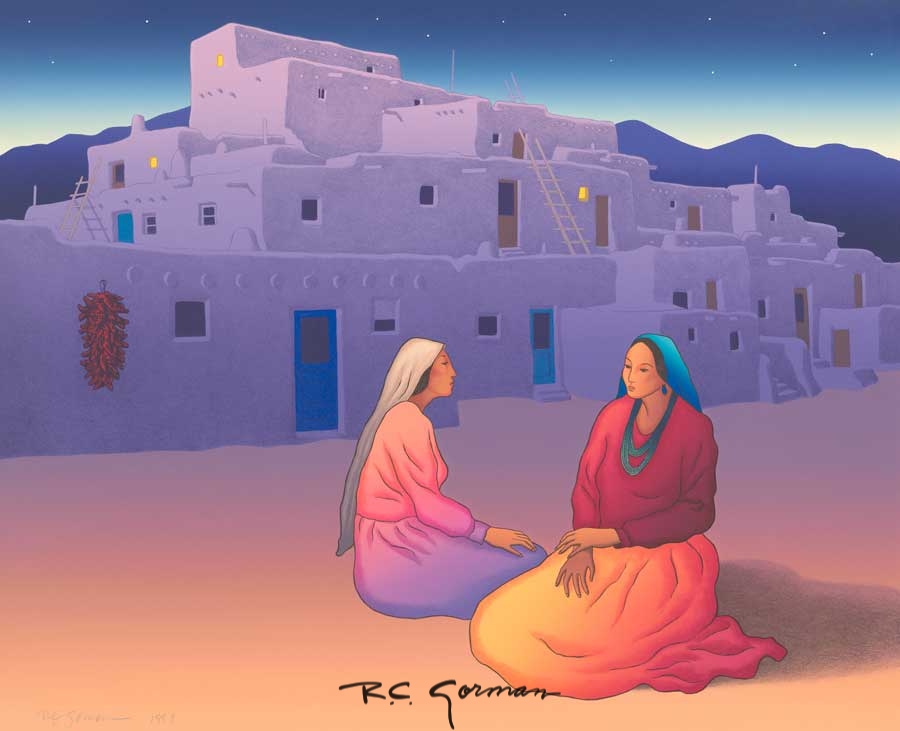
I began keeping Gorman’s diaries in 1972. They were started at the suggestion of his tax advisor as a way to keep a record of his travel and entertainment expenses. The diaries also helped keep his charge cards in order—I can tell you where he had lunch on July 3, 1975; it was at La Doña Luz.
As my years with R.C. progressed, these journals developed into a chronicle of his career, how it was started, and how it kept on track. His exhibits, honors, interviews, and international tours were all detailed.
The focus of this catalogue, however, is to highlight the Gorman bronzes. The incidents described in the narrative, therefore, are meant as vignettes of his life in Taos over a period of thirty years. It is hardly the complete story. But, like Gertrude Stein, who wrote the autobiography of Alice B. Toklas, I can’t wait to start on the Gorman Memoirs.
Prelude Mexico, San Francisco, and the beginnings of Gorman’s distinctive artistic language.
Prelude
Before moving to Taos, R.C. Gorman had enjoyed an active career in several venues. During a stint in the Navy, he drew portraits of his fellow sailors’ girlfriends. Borrowing on the style of Alberto Vargas, he glamorized the home-town girls for a small fee, and always managed to have extra spending money.
After his discharge from the Navy, the Navajo People awarded Gorman their first scholarship to study art abroad. He spent a Bohemian year studying at Mexico City College, now known as the University of the Americas. Gorman thrived under the influence of the Mexican masters: Orozco, Rivera, Siqueiros, and Tamayo. He never met any of these artists, and he never studied directly with them, but their influence on his art was tremendous. Their use of color and freedom of style stimulated his imagination. Why couldn’t he apply this same freedom when depicting his own people and traditions?
During this time, the contemporary Indian art movement as we know it today was nonexistent. Indian art was confined to the “traditional” style encouraged by the Indian art schools. Gorman had no bonds to this style. He was unique. He experimented randomly.
His approach to drawing, especially, developed almost by accident during this year in Mexico. As he hurried from an oil painting class to a drawing class, he cleaned his brushes on the butcher paper on which he drew with a grease pencil. Then when he worked on the oily paper, the pencil grease partially dissolved and gave a marvelous washed effect, so he added color using turpentine as a medium. He developed and refined this technique and still uses this approach forty years later.
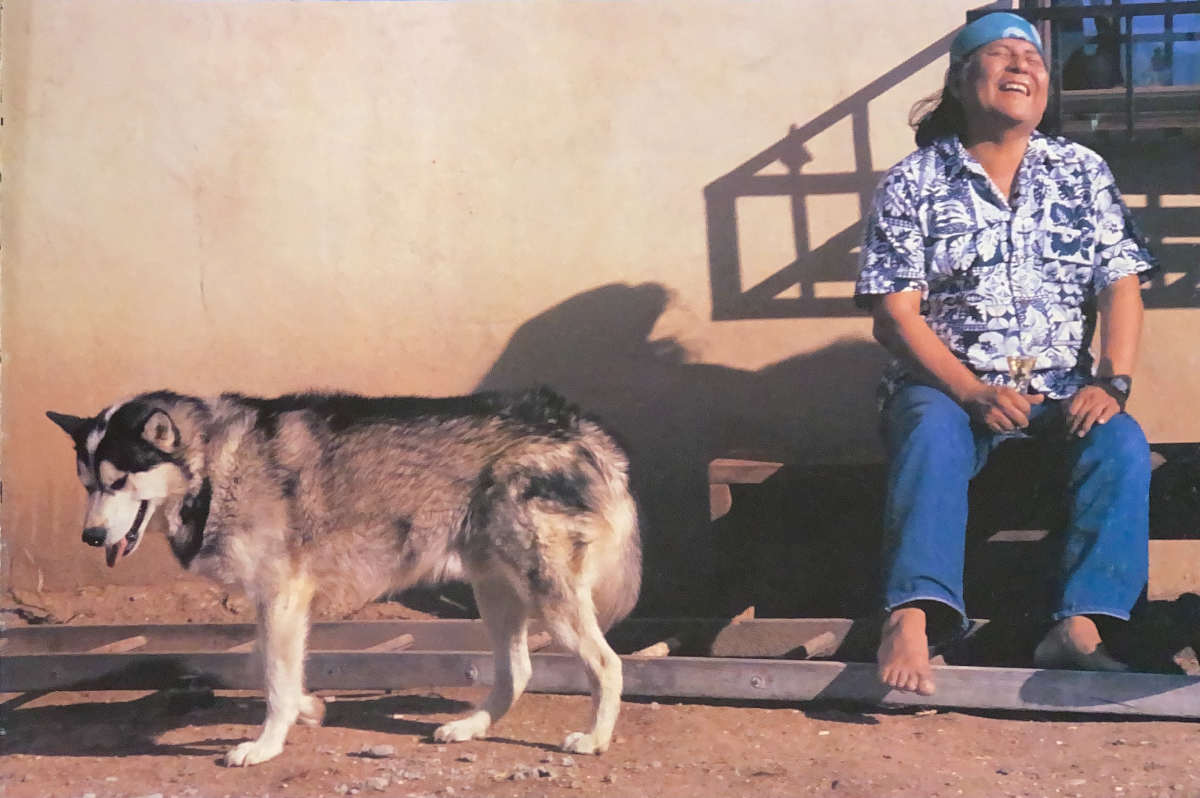
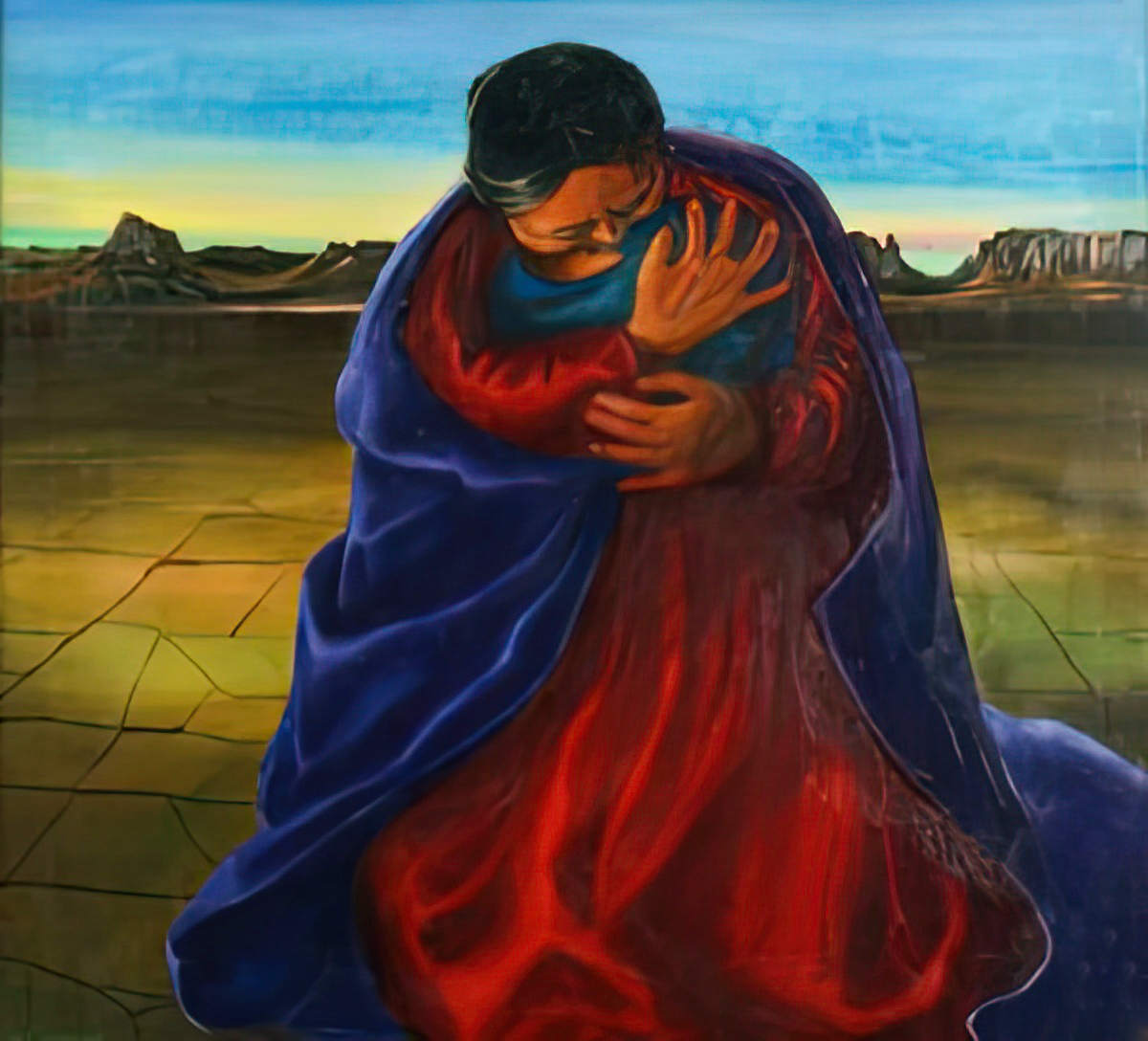
Gorman says he never mastered Spanish in Mexico (he actually knows more than he claims), but returned speaking broken English instead. “English is still my second language. Navajo is where it’s at.”
After Mexico, Gorman moved to San Francisco and established his first studio. He was the stereotypical struggling, if not starving, up-and-coming artist. To supplement his income, R.C. worked as an artists’ model for several university and private classes throughout the Bay area. This proved an invaluable experience in his training. While posing, he wasn’t able to participate in the classes, or receive critiques from the instructors, but he listened, observed, and absorbed the knowledge of several masters.
In San Francisco Gorman’s artistic output was prodigious. It was here that he painted the abstract canvases based on Navajo rug designs and Pueblo pottery patterns that brought him his first recognition. His career started to jell; he had more than a dozen one-man exhibitions and two-man exhibits with his father, Carl N. Gorman. He also competed successfully in Indian art competitions, bringing home first place awards in painting and drawing.
In 1967, an oil painting titled “Desert Mother” won first place at the American Indian Heritage Art Exhibition in Oklahoma City. His lithograph “Navajo Mother in Supplication” won second place. “That’s great,” he was heard to remark, “but what happened to my third entry?”
The Founding Years The move to Taos and the founding of the Navajo Gallery on Ledoux Street.
Artist Story
The Founding Years
In 1964, Gorman visited Taos for the first time. He roamed onto Ledoux Street and into the Manchester Gallery, which was located in the same building that houses the Navajo Gallery today. Photographs of R.C.’s work impressed the owner, John Manchester, who offered to mount a show in the gallery the following summer. The exhibit sold out, as did others in 1966 and 1967.
The Navajo Tribe observed its Centennial Year in 1968. Celebrations of the Long Walk from captivity at Bosque Redondo spotlighted the Navajo people, with special attention paid to Gorman’s art work. The only political painting of his career commemorated the Long Walk and won numerous awards (read bibliography). While preparing paintings for the Heard Museum in Scottsdale, however, he cut his right hand on a broken glass. The wound required eighteen stitches and stopped his efforts for several months, but not his expectations.
Back in Taos, Mr. Manchester had moved his gallery to the outskirts of town. His building on Ledoux Street was put on the market, and Gorman decided to buy it. Deals were drawn up, promises were made, and late in the year the historic building, parts over 200 years old, with plenty of ghosts and charm, was his. The dramatic Great Room became a perfect studio space; other rooms became the gallery and his home. Another milestone for R.C., this was the first Indian-owned fine art gallery in the United States. He named the gallery in honor of his own people and moved in. The first group exhibition was in May of 1969. The gallery roster included Patrick Swazo Hinds, Robert Draper, Al Momaday, Helen Hardin, Pablita Velarde, Charles Lovato, Cynthia Bissell, Dorothy Brett, and R.C.’s father, Carl Gorman.

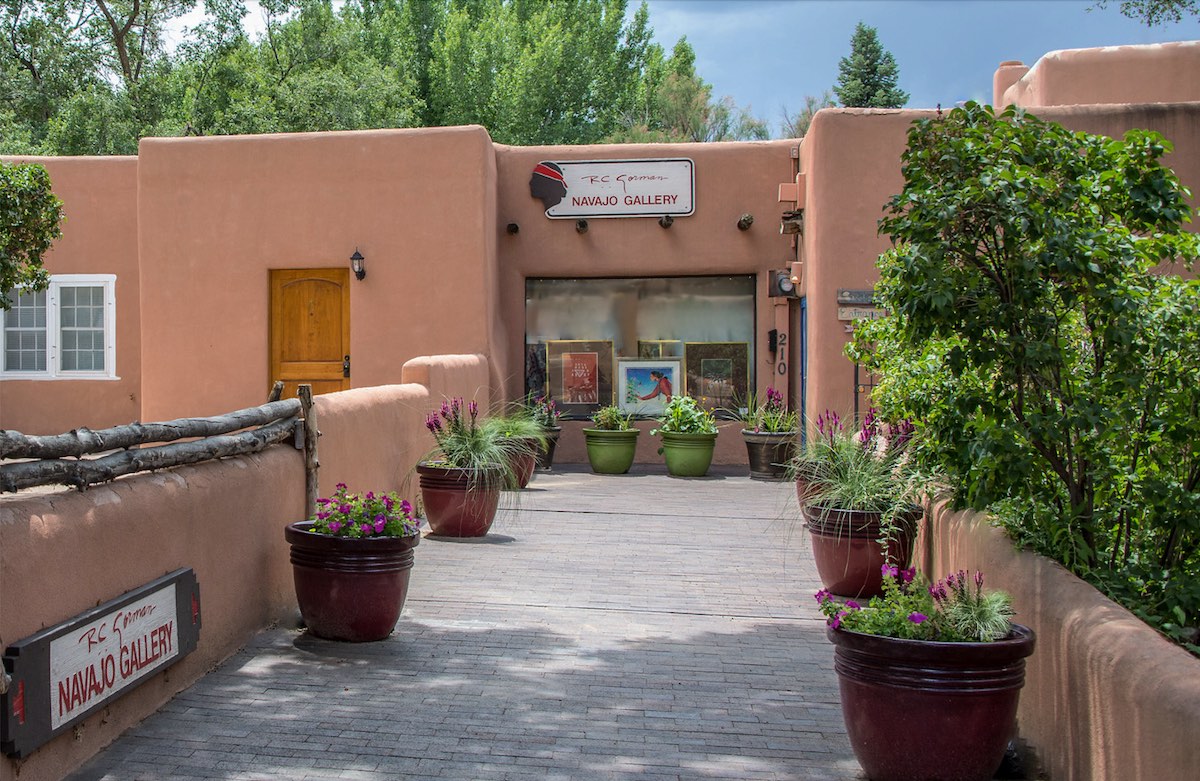
Gorman shared the success of his gallery with other artists he admired. Even though the gallery building also served as his private home, every room from his dining room to his notorious nude-filled bathroom displayed art. Supporting a stable of other artists provided the challenge Gorman needed to work hard. As the gallery developed, though, most of the other artists dropped out because of lack of sales, and it became apparent that the gallery should be a showcase for Gorman alone.
Social life revolved around the gallery; Gorman enjoyed hosting parties, weddings, and all sorts of happenings during the Hippie Age. Gallery procedures were relaxed and unorthodox in those early days. Ledoux Street hadn’t been discovered yet, and gallery hours changed according to R.C.’s schedule. An imaginative approach to running an art gallery, this flexibility suited Gorman’s way and enchanted his patrons. Anyone drifting in could easily be invited to dinner, sold a painting, or be asked to step gingerly around his pet pig, iguana, or skunk.
Imagine Ledoux Street when the gallery was founded. It was a tiny, block-long, dirt path, completely residential except for the gallery and the Harwood Library. There was no street sign and no street lights. And no parking. The parking that was available was avidly guarded by the owners of the tiny houses lining the street. As it happened, Gorman’s property had only a driveway with no street rights at all.
A visitor would have to find the entrance to the driveway, walk up to the gallery window, duck under a low archway into a hidden courtyard, and find the swinging door which led, finally, to a surprisingly spacious gallery. “Where is the Navajo Gallery?” became the most-asked question of people roaming around with confusing street maps in hand.
Gorman approached this problem of “location, location, location” with characteristic humor. For some time he propped a Levy’s bread poster in the window instead of a work of art. “You don’t have to be Jewish to love Levy’s bread” proclaimed the archetypal Indian in the poster. R.C. liked the poster’s irony and kept it in his collection. It was so outrageously inappropriate that he figured people would come in just to see what the gallery was all about. It worked.
As visitors explored Gorman’s home, they often encountered him working at his easel, his model propped up, posing for his latest drawing, and entertaining him with the morning’s gossip. One reason so few studio photographs of these drawings exist is that clients bought them right off the easel. “I must always work with live models,” Gorman says. “The model sets the mood. If she’s sour, it shows. If she’s spontaneous and alive, so is my work.”

The Chaotic 70's Exhibitions, famous visitors, Andy Warhol, bronzes, and a decade constantly in motion.
Artist Story
The Chaotic 70's
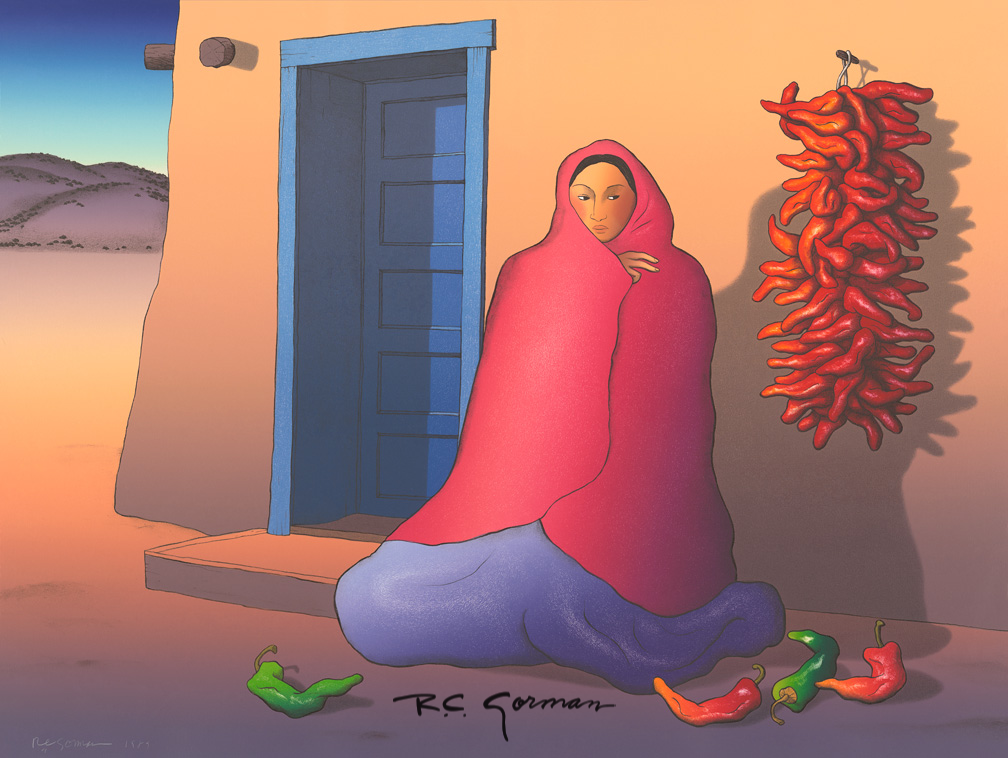
R.C. learned to drive in 1971 and bought an old jalopy from Rosalie Talbott, who has served as his home secretary for many years. His second vehicle was a practical van “to haul paintings around in.” That didn’t last long. Soon there was a Cadillac, followed by another Cadillac, a Lincoln Town Car, and then his succession of Mercedes. As he tried to maneuver his first Cadillac into his narrow driveway at the gallery, the passenger side experienced a mishap. Gorman ignored the damage completely, since it was on the other side and he couldn’t see it. That was his practice Cadillac. The second one missed a turn coming down the Ski Valley Road one summer day and landed in the river. Gorman escaped with an injured hand, this time his left one.
The women’s movement started in the 70’s, and ladies began using the anonymous “Ms.” title. Gorman presented the MS SIX exhibition in 1972 with his favorite women artists —another innovative concept.
1973 was an important year, with more than the usual schedule of exhibits at the gallery and elsewhere. Gorman offered Hopi artist Dan Namingha, recently discharged from the Marines, his first one-man exhibit. It was so successful that there were two more yearly exhibits before Dan moved on to a gallery in Scottsdale.
The Museum of New Mexico in Santa Fe presented R.C. Gorman and Fritz Scholder in their only exhibition together. It provoked comment from all sides. Scholder: “I have tried to paint the torture that it seems to me Indians go through. Anyone who looks at the history of the American Indian realizes it has been a sad history.”
In December, Gorman presented his “Ladies of Taos” exhibit, portraits of the famous and fun ladies that had become his friends. Among them: The Honorable Dorothy Brett, Cynthia Bissell, Regina Cook, Ali Ghito, Carolyn Parr, Nula Karavas, Martha Reed, Daria Hopper (one of Dennis’s ex-wives), Jackie McCarthy, and Little Mother, R.C.’s calico cat.
Gorman’s inclusion in the show “Masterworks from the Museum of the American Indian” at the Metropolitan Museum in New York marked a 1973 milepost. He was the only living artist to be included. The Museum was so impressed with his work that they purchased both drawings from the exhibit, and the New York Times dubbed him “the Picasso of American Indian art.” So, Gorman was the first Native American to list the Metropolitan Museum in his credits.
In the following years R.C. traveled cross country to as many as a dozen one-man shows a year. Hollywood discovered Taos in general, and Gorman in particular. Jeanne Cooper, of “The Young and the Restless,” started the trek up the gallery path, followed by Gregory Peck, Martha and Hal Wallis, Lee Marvin, Senator Barry Goldwater, Ruth Warrick, George Grizzard, Linda Lavin, and, eventually, Elizabeth Taylor, Arnold Schwarzenegger, Maria Shriver, Arlo Guthrie, and Danny DeVito. And on and on.
PBS filmed the first of many TV documentaries about Gorman in 1976. The six half-hour programs, collectively titled “American Indian Artists,” celebrated the Bicentennial by presenting a memorable cast: Allan Houser, Helen Hardin, Joseph Lonewolf and Grace Medicine Flower, Charles Loloma, Fritz Scholder, and Gorman. Twenty years later, friends write that they saw the series rerun in all parts of the country.
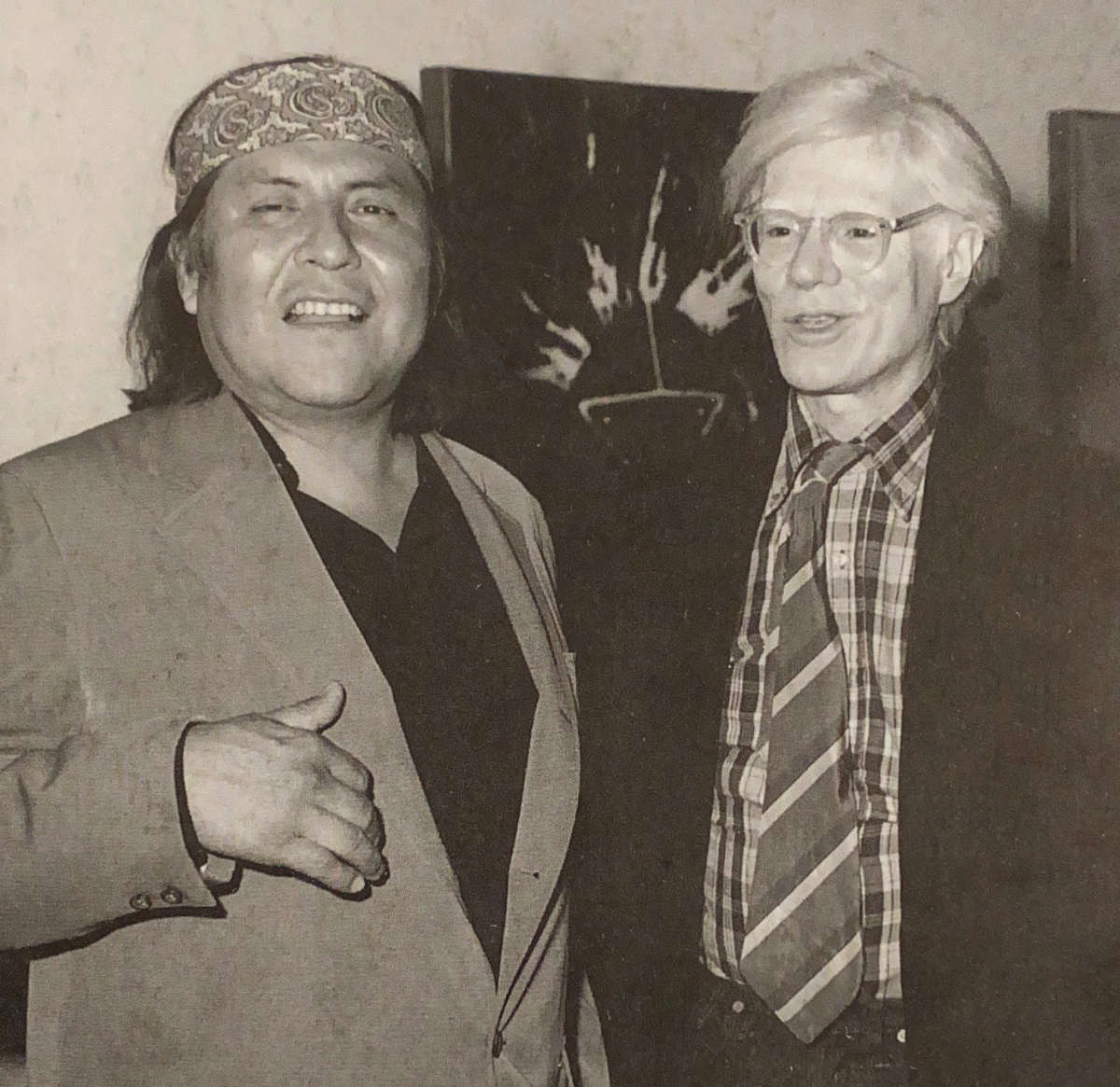
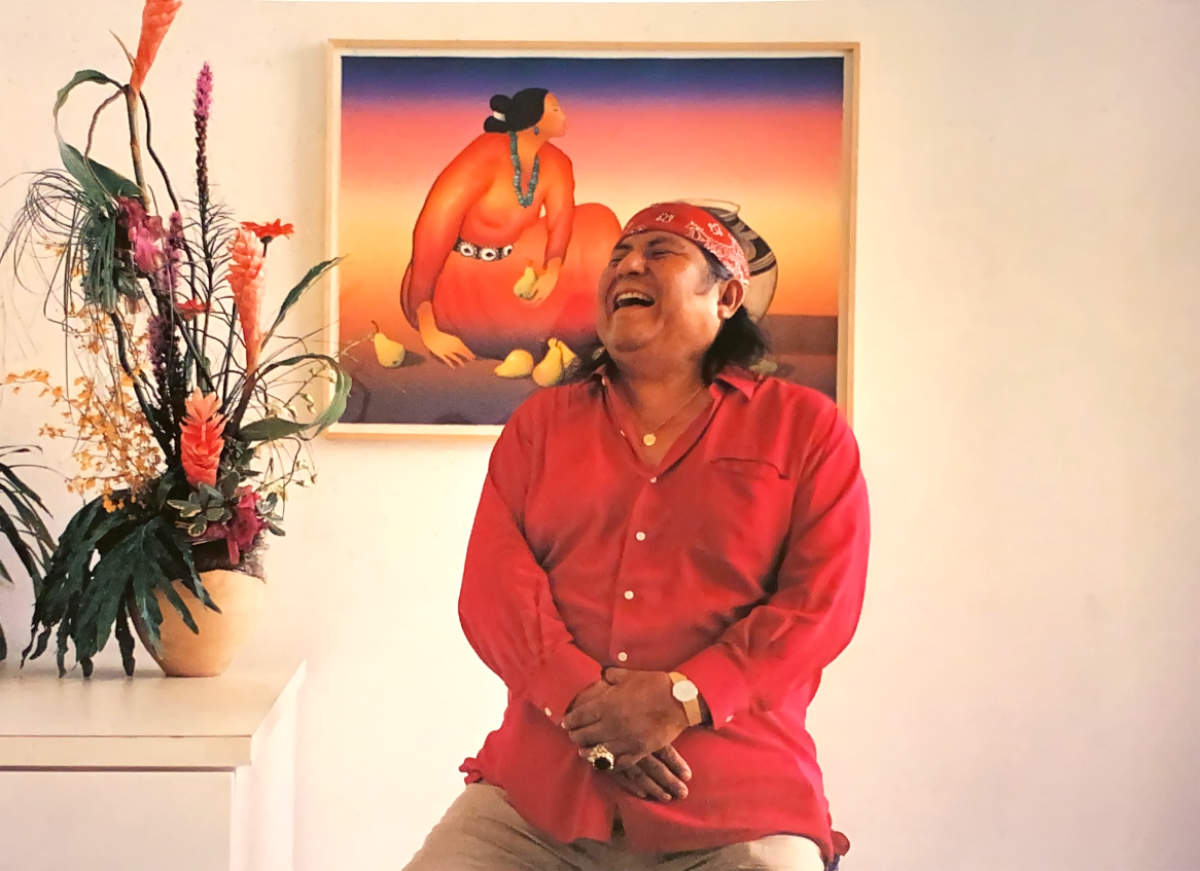
Gorman has never been avidly political, but he is an enthusiastic Democrat. In 1978, he was invited to Washington, D.C. for a dinner hosted by Vice President and Mrs. Walter Mondale in honor of the American Contemporary Artist. While dressing for the event, R.C. said he had dressed in a brother’s suit. Brooks Brothers, of course. R.C. was tickled to find himself seated at Mrs. Mondale’s right hand. Andy Warhol was seated on her left and rarely spoke. Several years later, President and Mrs. Jimmy Carter visited Taos on a skiing trip. Mrs. Carter made a point of introducing herself and her husband to R.C. during a dinner given in their honor. She was a charming fan, and Gorman sent her his NUDES AND FOODS cookbook.
As for Warhol, he and R.C. later became friends and collectors of each others’ work. Whenever Gorman visited the Big Apple, Warhol gave him the grand tour a la Studio 54 and other underbelly haunts. In 1978, they mounted a successful exhibit together in New York that was jokingly referred to as the show of “the odd couple.”
During these years, Gorman’s career as a lithographer burgeoned, as well as his first heroic efforts in bronze. He experimented in paper casts, ceramics, silkscreens, and even tapestries. The gallery became more and more viable, and the resulting responsibilities kept Gorman on the fast track.
January 8, 1979, was dedicated as “R.C. Gorman Day” in Taos. He was roasted, toasted, and given cheerful recognition by his fellow Taoseños. During the final toast, however, Mayor Phil Lovato remarked: “R.C. Gorman is an example of a spirit of Taos which attracts artists. There seems to be something about Taos that for many years has attracted the arts and inspired artists. We have before us a living example—the man we honor today.”
Nudes & Foods Studio life, hospitality, figure studies, recipes, and the playful Nudes & Foods story.
Artist Story
Nudes & Foods
The idea belongs naturally in Gorman’s late-1970s Taos story, where the studio, the dinner table, collectors, and friends often overlapped. His figure studies grew from working with live models, while the gallery’s social life made hospitality part of the R.C. Gorman legend.
Nudes & Foods brought those two worlds together: recipes, personality, and nude figure work gathered under one playful title. In the Taos narrative, the cookbook appears just after the Carter visit, when Gorman sent a copy to the First Lady.
The selected Nude works are kept in a link-only collector archive rather than the main catalog browsing paths.
A Home Where Art Can Run Amuck Casa Gorman, collecting, travel, entertaining, and an increasingly international career.
Artist Story
A Home Where Art Can Run Amuck
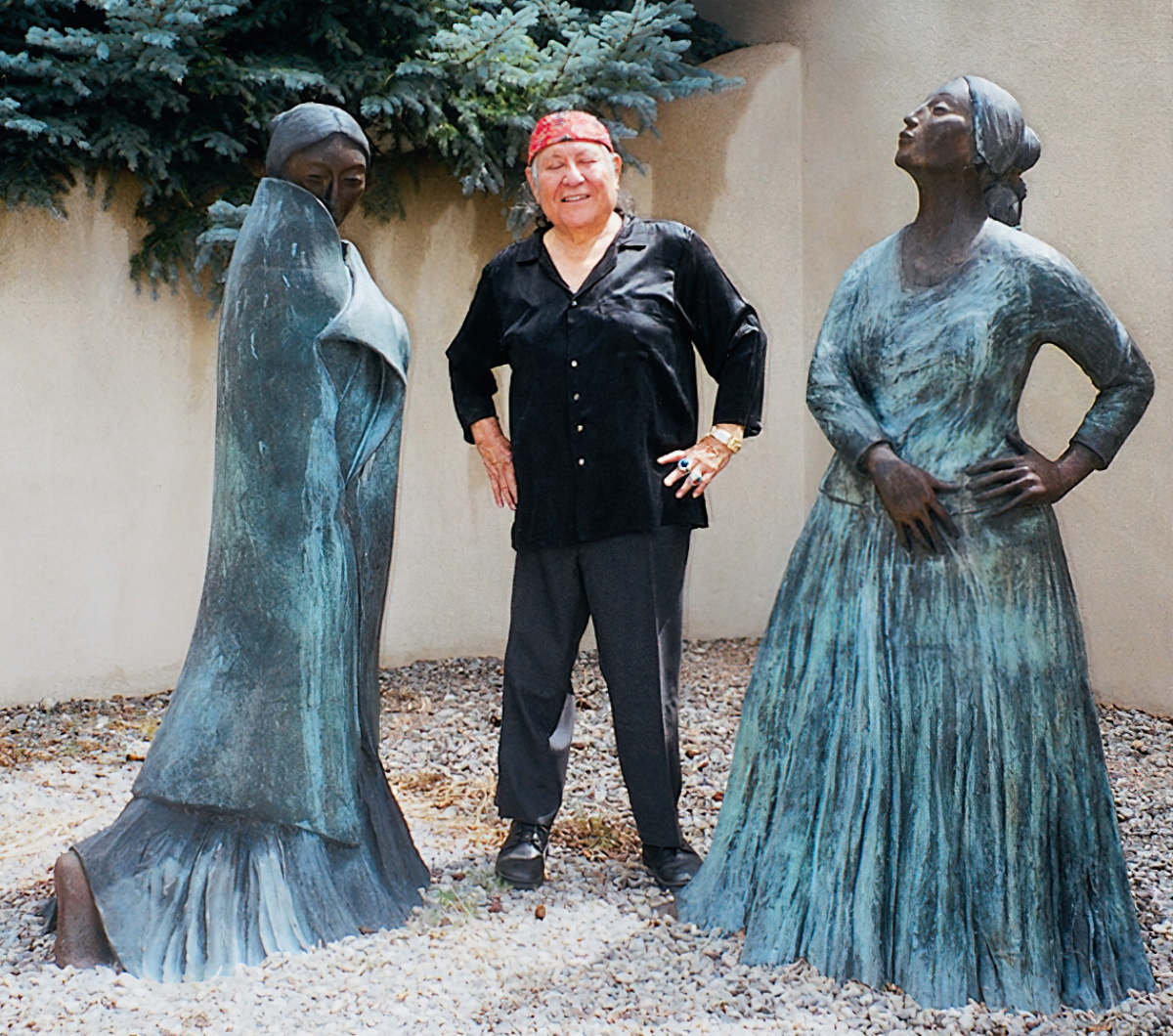
Gorman’s home on Ledoux Street was perfect for the gallery, but it was getting crowded. He needed more room, more privacy, and space for his personal art collection. Again he bought another old adobe fixer-upper, which had originally been a sheepherder’s cabin, so he felt right at home.
Casa Gorman, situated just north of Taos with a liberating view of Taos Mountain, needed a lot of work. Gorman wasted no time creating a ballroom-sized studio, an Olympic-length swimming pool, a guest house, a new kitchen, a library, a wider living room, and a Japanese style sculpture garden. The only rooms left of the original house were R.C.’s bedroom and a jacuzzi room built by hippies two owners back. He suffered from the same building fever as the Medici Popes.
All this activity resulted in a stunning home that only Gorman could have conceived. It inspired him to start collecting art seriously—Miros, kachinas, a few Picassos and Chagalls, and elephants from India. He supported promising young artists, or the latest kitsch, whatever caught his eye. And art was placed everywhere. The model’s dressing room had no mirror so there was more room for pictures. One fine day R.C. bought a concert grand Steinway in the morning and a new Mercedes in the afternoon. After his years of work, this kind of cheerful extravagance was fun.
The work continued, of course, and Gorman was more productive than ever. The grueling travel schedule exhausted everyone, except Gorman, who flourished. Trips to Japan resulted in a collection of woodblocks which are treasured by collectors as small, perfect jewels. His increasingly numerous tours of Europe always coincided with exhibitions and printing projects in France, Germany, Italy, and Spain. His international clientele increased with each appearance. Charm, humor, and art speak the same language.
During the 80’s the large format books on Gorman’s art started rolling off the presses of national publishers. Each book played a part in educating a wide audience in Gorman’s background, his family, and his flamboyant personality. The universality of his art grew stronger. His new home brought out Gorman’s hospitality; yet another First Lady came for a private visit. This time it was Jacqueline Kennedy. She was gracious and generous of spirit, and those who met her that quiet day will never forget her. Her poise and gentle demeanor impressed Gorman as well.
The hectic pace of the 80’s finally felled Gorman in 1985. His gallbladder became infected, it burst, and required major surgery and several months’ recovery. He kept his wit intact through the ordeal, always eager to give advice to friends experiencing the same problem. “It’s really awful,” he assured them. “Worse than giving birth or having heart surgery.” Not that he would know.
The next year, fully recuperated, Gorman tackled a full schedule of exhibitions. Returning home from Europe in the spring, he visited Cambridge to receive Harvard University’s Humanitarian Award. This prompted him to endow an annual scholarship for Taos High School students of Indian and Hispanic descent. On the other coast, Mayor Dianne Feinstein dedicated another R.C. Gorman Day in San Francisco.
In 1986 Gorman decided that the Navajo Gallery would host his annual Indian Market Exhibition in Taos, instead of in a Santa Fe gallery. It is now an annual event, scheduled for the Thursday before the actual market starts on Friday in Santa Fe. Other Taos galleries followed his lead, and now a full docket of shows opens on that day. Traffic jams on the road between Santa Fe and Taos that afternoon present a real problem, but most of the visitors return to Santa Fe pleased with their new Gorman drawing, litho, bronze, book, or poster.
Is Imitation the Finest Form of Flattery? Forgeries, bronze sculpture, the Navajo Code Talkers, and Gorman’s later Taos years.
Artist Story
Is Imitation the Finest Form of Flattery?
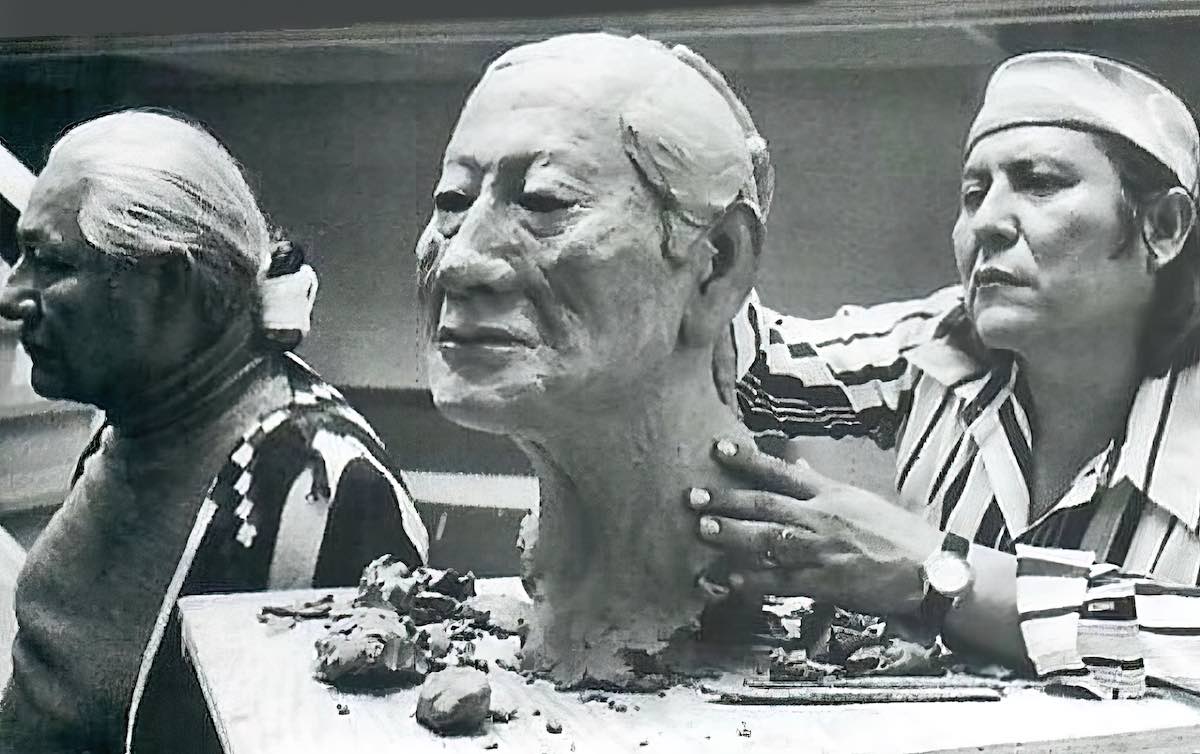
There have always been artists who use Gorman’s style for their inspiration. In other words, they’ve copied him to one degree or another, though they sign their own names. In 1987, however, there appeared a scattering of very inexpensive “Gorman originals.” R.C. was sent photos of these drawings for appraisal, and it became clear that they weren’t his. They were copies done by a clever lady forger who specialized in Gorman, Georgia O’Keeffe, and Agnes Martin. She also practiced medicine without a license and was living in the United States without permission of the Swiss or U.S. governments.
R.C. has always admired strong-willed women and finds the lady’s saga continuously entertaining. Is she still in jail for the O’Keeffe caper? Has she been deported again? Does she claim a law degree now, or has she gone back to photography? She has a website where you can keep up with her, but I can’t reveal her name because she claims innocence. Maybe you could punch in “forger.com” and see what happens. Moral: If someone offers you a Gorman drawing for much too low a price, look at it very carefully.
Gorman executed his first bronzes in San Francisco in the spacious studios of Editions Press. When that concern fell victim to the gamble of speculators, R.C. decided to produce the bronzes himself, using the Shidoni Foundries outside of Santa Fe. He sculpted the clay models in his Taos studios, then hauled them down to Shidoni where expert artisans supervised the castings. R.C. checked on the progress of each sculpture with a quick side-trip on his way to lunch in Santa Fe. This successful collaboration produced eleven bronzes in as many years.
In 1995, Gorman dedicated a heroic bronze portrait of his father in honor of the Navajo Code Talkers. Carl Gorman was the oldest of the original twenty-nine Navajos who volunteered to form a secret division of the Marine Corps. They coded the Navajo language among themselves and were scattered across the Pacific during World War II. It was dangerous duty, but the Japanese never broke the code.
Most Americans had never heard of the Code Talkers. Only in recent years has their story been told and have they received recognition. It was a poignant ceremony, then, when this bronze was dedicated on Veteran’s Day and donated to the campus of R.C.’s alma mater, Northern Arizona University in Flagstaff. The Gorman family, several dozen of the remaining Code Talkers, appropriate dignitaries, and hundreds of Native American students attended the ceremony. The bronze remains on the campus as a tribute to the men who served so honorably and as a monument for the younger generations’ aspirations.
When R.C. was asked about what the Code Talkers and their service to the country meant to him, he said: “You need to talk to my father and the rest of the men. They were there. They served. I was not there.”
Believe it or not, the bronze has caused some controversy. But nothing compared to the uproar stirred up when Gorman attended a luncheon for the 500th anniversary of Columbus’ arrival in the New World. The guest of honor was a descendant of Columbus, the Duke of Veragua, and Native American protesters were clustered around the entrance, banners waving. They were angered to see R.C. there, looking as one wag said “like a Cartier yard sale.”
He was dressed in lots of gold—rings, bracelets, any gold he could find. He told the Duke, “The Spanish came here for this,” pointing to his tinsel. “So, I’m bringing it to you.” The Duke laughed and tensions settled down.
Knee surgeries and a knee replacement have slowed R.C. a little. Even though he’s recovered completely and sticks to a strict exercise regime, he has little inclination to race around to the almost monthly exhibits as he did previously.
His 1998 schedule included exhibits at the Adagio Gallery in Palm Springs, the East-West Center in Honolulu, and the Four Winds Gallery in Australia. Then a European tour with his sister, Donna, and work on a lithograph at the Lithografia R. Bulla press in Rome. In August the Navajo Gallery celebrates the Thirtieth Year Anniversary Celebration. After that, he’s off again.
Does R.C. have plans for the future? Of course he does, but he says: “I don’t plan things. If you plan too much and it doesn’t work, you can be disappointed. So I don’t worry about the future. It always seems to get here… but there’s no retirement in sight so far.”
Ms. Dooley wrote this essay as part of the book, The Taos Diaries 1968-1998, which commemorated R.C.’s 30th anniversary in Taos. Virginia Dooley directed Navajo Gallery activities until 2007. She died in Taos in April 2008.
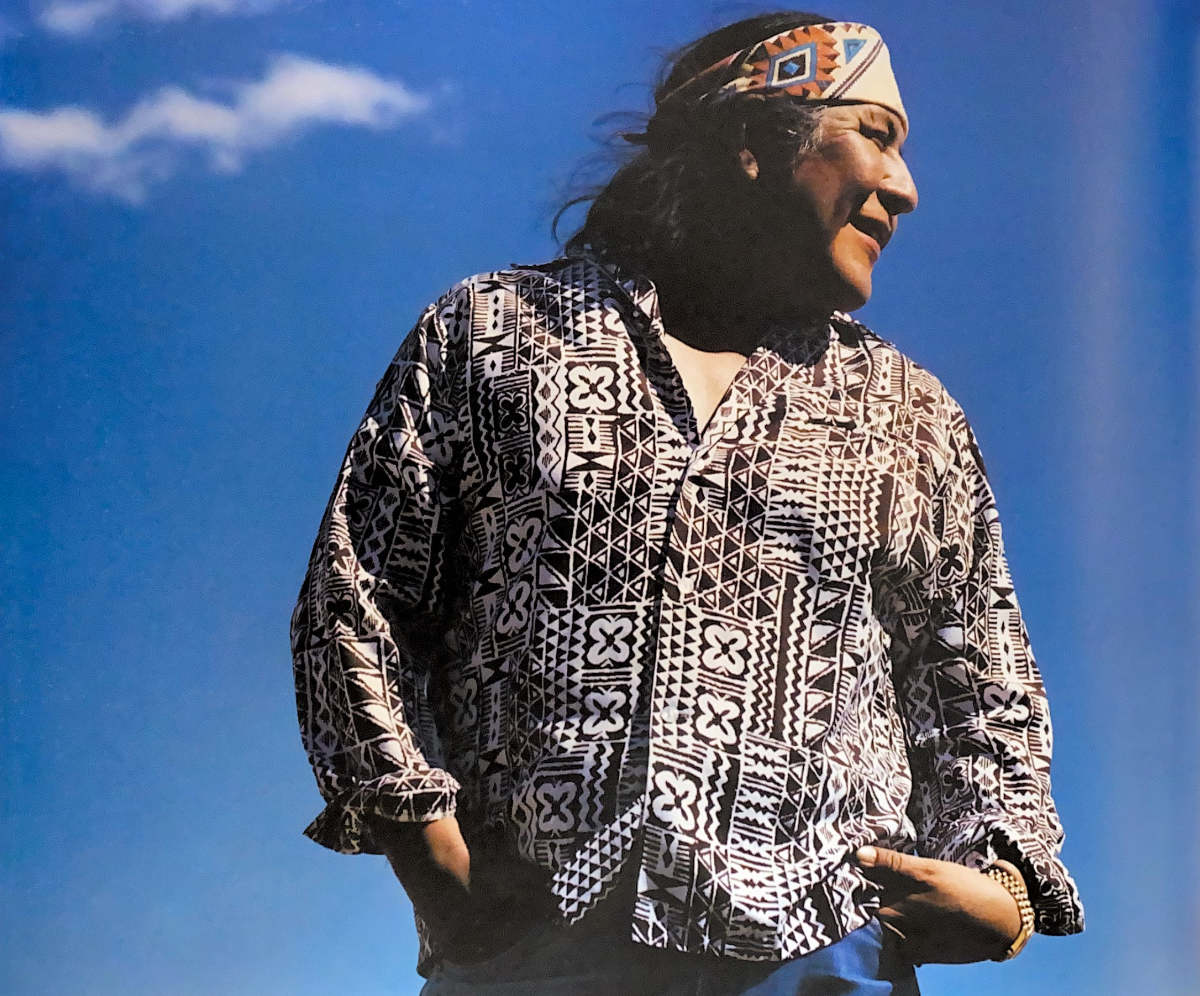
View the gallery.
Find originals, giclee reproductions, sound art items, and gift collection in the Gallery.